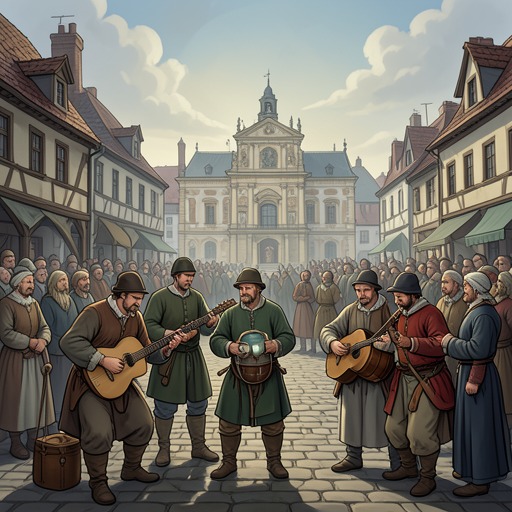
Holy Empire of Music
Last and First MenThe Holy Empire of Music grew from a faith that treated music not as ornament but as the deepest reality of existence. A ruler’s conversion and worldwide conquest turned that doctrine into a political order, whose intricate laws held society together for a millennium even as later believers disputed whether the church had preserved or suppressed the faith’s original spirit.
Doctrine and the Prophet
The faith began with a prophet born in a highland village where belief in music was intense but had not yet been formulated as doctrine. He learned to move peasant audiences between great joy and sorrow, then taught that music was reality and the rest of existence an illusion. A melody vanishes when it ends, yet music can begin again without losing its freshness; its true home, he argued, lies beyond time. Human beings and other living creatures with a gift for music likewise possessed an enduring musical soul, whose standing in eternal life depended on originality and proficiency.
This teaching made salvation a matter of awakening the soul through melody and harmony. Its promise was at once individual and universal: each person could aspire to an eternal musical life, while music itself offered a pattern of passage, disappearance, and renewed presence. The doctrine spread rapidly, carried by the prophet’s melodies as well as his ideas.
From Popular Faith to World Rule
The growing movement threatened the established order. Officials tried to suppress its music partly because they considered it disruptive to agricultural work, but also because its emotional force reached courtly women and challenged a social refinement built over centuries. Its adherents further disputed the authority of aristocratic birth and formal musical training, insisting that spontaneous expression mattered more than inherited rank or mastery of established forms. Persecution strengthened the movement: its martyrs were remembered as singing triumphantly even in the flames.
The decisive political turn came when the sacred monarch declared that he had adopted the people’s faith, acting partly from conviction and partly from policy. The existing bureaucracy gave way to an enlightened dictatorship, and the monarch took the title Supreme Melody. With the movement’s popular support and rapid spread abroad, he conquered the world and founded the Universal Church of Harmony. The prophet did not direct this transformation. Alarmed by how easily his teaching had succeeded, he had withdrawn to the mountains to develop his art in solitude. The emperor’s military bands and choirs eventually brought him to the capital; after a struggle, he was confined in the High Temple of Music and treated by the government as an oracle to be interpreted. The temple’s official music and constant delegations drove him into madness, a condition that made him more useful to the authorities.
The Empire’s Law and Social Order
The Holy Empire of Music gave the species order and purpose for a thousand years. Rulers interpreted the prophet’s sayings into a legal system that gradually displaced local codes under the authority of the new religion. Its origins lay in a doctrine of intense personal experience, but its durable achievement was institutional: a complex body of law expressed the practical needs, rights, and obligations of human beings through the fiction that every person was a melody requiring completion within society’s greater musical theme.
The account presents the empire’s reason and religious language as inseparable but not identical. Its root was described as madness, while its eventual expression became intricate common sense adorned with what the chronicler calls precious and harmless follies. This contrast helps explain how an ecstatic popular faith could become a stable system of governance: the original musical metaphor gave authority to social obligations, while the resulting law addressed the ordinary organization of collective life.
Schism and Historical Significance
Near the end of the millennium, the devout divided over what the religion had become. One fervent sect argued that ecclesiastical rule had stifled the prophet’s central teaching: salvation through an individual’s emotional experience of divine music. In the official church’s view, salvation had shifted away from subjective experience toward compliance with obscure rules of musical technique. The dissenters also accused churchmen and statesmen of reshaping the supposed laws of music to suit social convenience, until the faith’s living spirit had been lost.
A counter-revival challenged the rebels in turn. Its adherents mocked what they saw as the dissenters’ self-absorption and urged devotion to music’s ordered forms rather than to personal emotion. The surviving account establishes the conflict but does not resolve it. The empire’s history thus turns on a lasting contradiction: music could authorize both inward freedom and collective order, but institutions built in its name could make the forms of faith more important than the experience that had first animated them.